 |
 |
3W FM
Transmitter
source:
http://www.aaroncake.net/
By
Rae XL Tkacik
-
This is the
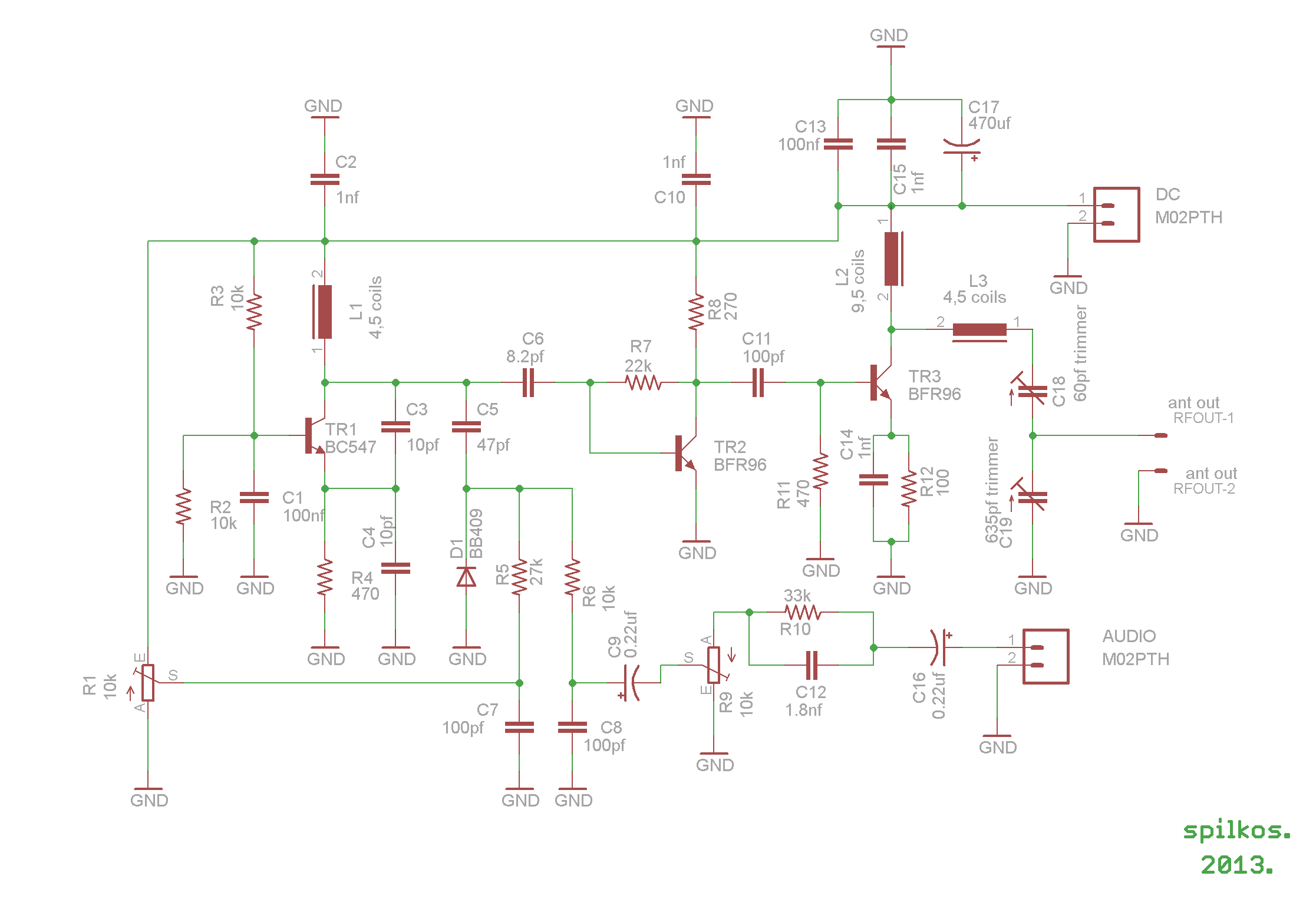
schematic for an FM transmitter with 3 to 3.5 W output power
that can be used between 90 and 110 MHz. Although the stability
isn't so bad, a PLL can be used on this circuit.
This is a circuit
that I've build a few years ago for a friend, who used it in
combination with the BLY88 amplifier to obtain 20 W output
power. From the notes that I made at the original schematic, it
worked fine with a SWR of 1 : 1.05 (quite normal at my place
with my antenna).
-
Schematic

Parts:
|
Part |
Total Qty. |
Description |
Substitutions |
|
R1,R4,R14,R15 |
4 |
10K 1/4W Resistor |
|
|
R2,R3 |
2 |
22K 1/4W Resistor |
|
|
R5,R13 |
2 |
3.9K 1/4W Resistor |
|
|
R6,R11 |
2 |
680 Ohm 1/4W
Resistor |
|
|
R7 |
1 |
150 Ohm 1/4W
Resistor |
|
|
R8,R12 |
2 |
100 Ohm 1/4W
Resistor |
|
|
R9 |
1 |
68 Ohm 1/4W
Resistor |
|
|
R10 |
1 |
6.8K 1/4W Resistor |
|
|
C1 |
1 |
4.7pF Ceramic Disc
Capacitor |
|
|
C2,C3,C4,C5,C7,C11,C12 |
7 |
100nF Ceramic Disc
Capacitor |
|
|
C6,C9,C10 |
3 |
10nF Ceramic Disc
Capacitor |
|
|
C8,C14 |
2 |
60pF Trimmer
Capacitor |
|
|
C13 |
1 |
82pF Ceramic Disc
Capacitor |
|
|
C15 |
1 |
27pF Ceramic Disc
Capacitor |
|
|
C16 |
1 |
22pF Ceramic Disc
Capacitor |
|
|
C17 |
1 |
10uF 25V
Electrolytic Capacitor |
|
|
C18 |
1 |
33pF Ceramic Disc
Capacitor |
|
|
C19 |
1 |
18pF Ceramic Disc
Capacitor |
|
|
C20 |
1 |
12pF Ceramic Disc
Capacitor |
|
|
C21,C22,C23,C24 |
4 |
40pF Trimmer
Capacitor |
|
|
C25 |
1 |
5pF Ceramic Disc
Capacitor |
|
|
L1 |
1 |
5 WDG, Dia 6 mm, 1
mm CuAg, Space 1 mm |
|
|
L2,L3,L5,L7,L9 |
5 |
6-hole Ferroxcube
Wide band HF Choke (5 WDG) |
|
|
L4,L6,L8 |
3 |
1.5 WDG, Dia 6 mm,
1 mm CuAg, Space 1 mm |
|
|
L10 |
1 |
8 WDG, Dia 5 mm, 1
mm CuAg, Space 1 mm |
|
|
D1 |
1 |
BB405 |
BB102 or equal
(most varicaps with C = 2-20 pF [approx.] will do) |
|
Q1 |
1 |
2N3866 |
|
|
Q2,Q4 |
2 |
2N2219A |
|
|
Q3 |
1 |
BF115 |
|
|
Q5 |
1 |
2N3553 |
|
|
U1 |
1 |
7810 Regulator |
|
|
MIC |
1 |
Electret
Microphone |
|
|
MISC |
1 |
PC Board, Wire For
Antenna, Heatsinks |
|
Notes:
1. Email
Rae XL Tkacik with questions,
comments, etc.
2. The circuit has
been tested on a normal RF-testing breadboard (with one side
copper). Make some connections between the two sides. Build the
transmitter in a RF-proof casing, use good connectors and cable,
make a shielding between the different stages, and be aware of all
the other RF rules of building.
3. Q1 and Q5 should be
cooled with a heat sink. The case-pin of Q4 should be grounded.
4. C24 is for the
frequency adjustment. The other trimmers must be adjusted to
maximum output power with minimum SWR and input current.
5. Local laws in some
states, provinces or countries may prohibit the operation of this
transmitter. Check with the local authorities.
 |
|